
Solutions / AI Penetration Testing
AI Penetration Testing (AIPT)
Secure your AI-enabled applications, including chatbots, RAG systems, AI agents, and APIs, with specialized, hands-on penetration testing built for how AI systems are really attacked.

Generative AI has moved from the experimental stage to production, and attackers have quickly followed. AI-enabled systems introduce an attack surface that traditional web and network penetration testing was never designed to cover. nGuard’s AI Penetration Testing (AIPT) targets the unique vulnerabilities of business AI deployments, including customer-facing chatbots, RAG assistants, autonomous AI agents, AI-powered APIs, and embedded LLM features. Depending on scope, our testing reveals risks such as prompt injection, sensitive data leakage, insecure output handling, excessive agent autonomy, authorization bypass, and more.
Whether you’ve deployed a chatbot, RAG assistant, autonomous agent, or AI-powered API, our AI Penetration Testing combines proven methodology with AI-specific attack techniques. We identify how a real-world attacker could manipulate your model, exfiltrate data, or abuse connected systems, then deliver prioritized, actionable remediation guidance to secure your environment.
Comprehensive AI Application Security Assessment
Testing Methods
Simulating Anonymous Threats
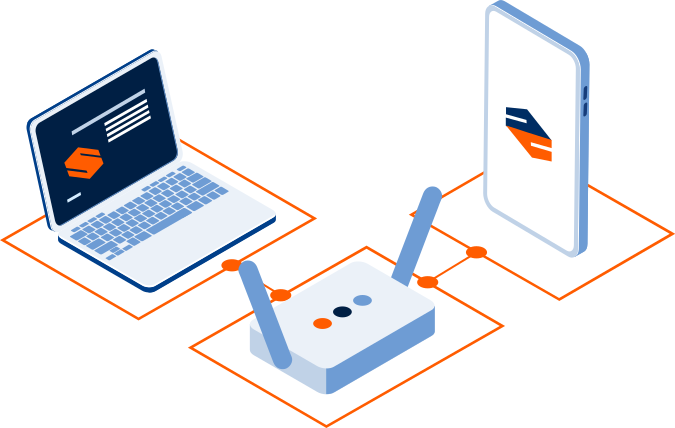
This phase simulates real-world attacks from an unauthenticated perspective, targeting your AI application, model interface, and APIs with no valid credentials, whether the asset is internet-facing or restricted to internal or whitelisted users. Our experts probe the exposed attack surface as an external attacker would, identifying prompt injection vectors, information disclosure, system prompt leakage, and vulnerabilities in how untrusted input reaches the model.
Authenticated Testing
nGuard performs testing using valid user credentials across each application role to simulate attacks from legitimate or compromised users. This phase focuses on authorization bypass, privilege escalation across AI roles, unauthorized data access mediated by the model, and unintended information disclosure. We verify that role boundaries remain intact even when the AI is manipulated.
Advanced Testing Techniques
Our assessments go far beyond automated scanners. Using specialized AI testing toolsets and hands-on manual techniques, we evaluate your system against direct and indirect prompt injection, jailbreaks, context manipulation, instruction override, RAG and embedding poisoning, model and data extraction, and insecure output handling. Testing is aligned with the frameworks relevant to your environment, including the OWASP Top 10 for LLM Applications and the attack techniques documented in MITRE ATLAS.
Comprehensive Vulnerability Checks
AI Penetration Testing examines the full AI attack surface: the model and its prompts, every connected API and endpoint, the data and retrieval pipeline, and the downstream systems the AI can act on. We assess excessive agency and over-permissioned tool use, supply-chain and plugin risk, and how unvalidated model output flows into your application. This thorough approach ensures AI-specific and traditional application vulnerabilities are identified and addressed together.

What AI Penetration Testing Identifies
nGuard’s AI Penetration Testing methodology applies the relevant testing frameworks and methodologies, such as the OWASP Top 10 for LLM Applications, MITRE ATLAS, and the NIST AI Risk Management Framework. Common test vectors include:
- Prompt Injection (OWASP LLM01): Direct and indirect attempts to override system instructions, manipulate model behavior, or smuggle hidden instructions through documents, web content, and other untrusted input.
- Sensitive Data Leakage (OWASP LLM02): Exposure of PII, credentials, API keys, proprietary data, or confidential information through model responses.
- Supply Chain & Plugin Risk (OWASP LLM03): Compromised models, datasets, libraries, and third-party AI components.
- RAG & Data Poisoning (OWASP LLM04 & LLM08): Malicious documents, poisoned embeddings, and vector-store weaknesses that corrupt retrieval-augmented generation systems.
- Insecure Output Handling (OWASP LLM05): Unsanitized model output that enables downstream injection attacks such as XSS, SQL injection, or command injection.
- Excessive Agency (OWASP LLM06): Over-permissioned tools, elevated privileges, and autonomous actions that let a manipulated AI reach beyond its intended scope.
- System Prompt Leakage (OWASP LLM07): Disclosure of internal instructions, guardrails, and secrets embedded in system prompts.
- Authorization Bypass: Broken access controls and privilege escalation across application roles, including agent and tool-invocation boundaries.
Application types we test: AI-enabled web and mobile applications, AI chatbots, retrieval-augmented generation (RAG) applications, autonomous AI agents, machine learning systems, and AI-powered APIs.
Thorough AI Penetration Testing
Specialized Techniques for AI-Era Security

Realistic Attack Scenarios
nGuard simulates real-world attacks from both anonymous and authenticated perspectives, manipulating your AI the way a determined attacker would to give you a true picture of your security posture.

Industry-Standard Frameworks
Our testing applies the recognized AI security standards relevant to your environment, such as the OWASP Top 10 for LLM Applications, MITRE ATLAS, and the NIST AI Risk Management Framework.

Specialized AI Methodology
Automated scanners miss AI-specific flaws. AI Penetration Testing pairs proven penetration testing expertise with specialized AI testing techniques and toolsets built for how AI systems behave, such as model behavior, RAG pipelines, and autonomous agents.

Detailed, Actionable Reporting
nGuard delivers clear findings with prioritized, practical remediation guidance, so your team understands each vulnerability and knows exactly how to strengthen your AI application’s security.
AI Penetration Testing FAQ
What is AI penetration testing?
AI penetration testing (AI pen testing) is a specialized security assessment that identifies and exploits vulnerabilities unique to AI-enabled systems, such as chatbots, RAG assistants, AI agents, AI-powered APIs, and large language model features embedded in business applications. Unlike traditional web or network testing, it targets AI-specific risks such as prompt injection, data leakage, insecure output handling, excessive agency, and more that conventional security tools aren’t designed to detect.
How is AI penetration testing different from traditional web application pen testing?
Traditional pen testing focuses on software and network weaknesses. AI-enabled systems process and generate data in ways that introduce new attack surfaces, such as natural-language prompts, retrieval pipelines, and autonomous tool use. AI Penetration Testing covers both the AI-specific layer and the surrounding application and API infrastructure for full coverage.
What types of AI applications does nGuard test?
nGuard tests AI-enabled web and mobile applications, chatbots, retrieval-augmented generation (RAG) applications, autonomous AI agents, AI-powered APIs, machine learning systems, and large language model features embedded in business software, among others.
What standards and frameworks does AI Penetration Testing use?
AI Penetration Testing applies the frameworks relevant to what is being tested, such as the OWASP Top 10 for LLM Applications, MITRE ATLAS (a knowledge base of real-world attack techniques against AI systems), and the NIST AI Risk Management Framework.
What vulnerabilities does AI penetration testing find?
Common findings include prompt injection, sensitive information disclosure, system prompt leakage, insecure output handling, excessive agency, authorization bypass, supply-chain and plugin risk, and weaknesses in retrieval-augmented generation (RAG) data sources, among others.
How often should we test our AI applications?
AI threats evolve quickly, and models, prompts, and integrations change often. nGuard recommends testing at major releases and on a recurring basis, with follow-up testing to validate remediation.
TRUSTED BY THESE BRANDS





Security Resources from nGuard
“nGuard has been a proven cybersecurity partner with us for over five years that understands our industry.”
— Joe Warling, Randolph Electric Membership Corporation

“nGuard not only does a thorough pen test, their remediation recommendations and tracking tool was a big help in addressing issues.”
— Allan Patek, Executive Director, Wisconsin Insurance Security Fund

“nGuard’s expertise in cybersecurity, their professionalism and flexibility is the reason why we hire them year after year.”
— Frank M. Furnari, Business Systems Developer, NJCRIB (New Jersey Compensation Rating & Inspection Bureau)
“The staff at nGuard are top-notch cybersecurity professionals. I find their knowledge, guidance, and expertise very helpful during our annual pen tests.”
— David Schultheis, IT Manager, Nine Network of Public Media

“nGuard’s cybersecurity and PCI expertise has been instrumental in helping us improve our cybersecurity posture.”
— Mark Krawczyk, Director of Information Privacy, Purpose Financial

“We have trusted nGuard as our primary cybersecurity consultants for 20 years. Our continued choice of and reliance on nGuard year after year is a testament to the professionalism, expertise, and exemplary service that we continue to experience.”
— Jeremy Noble, VP, Information Services, Atlantic Telephone Membership Corporation

“I have used several other large assessors in the past and I recommend nGuard above all others.”
— Scotty Westbrook, IT Director, Sampson Bladen Oil Company

“Through our long-term partnership with nGuard, we gain valuable insight from their advanced cyber-security tests.”
— Lynn Sturkie, Director of Technology Services, Lexington County

Secure Your AI Applications
Let nGuard help you test and harden your AI before attackers do.